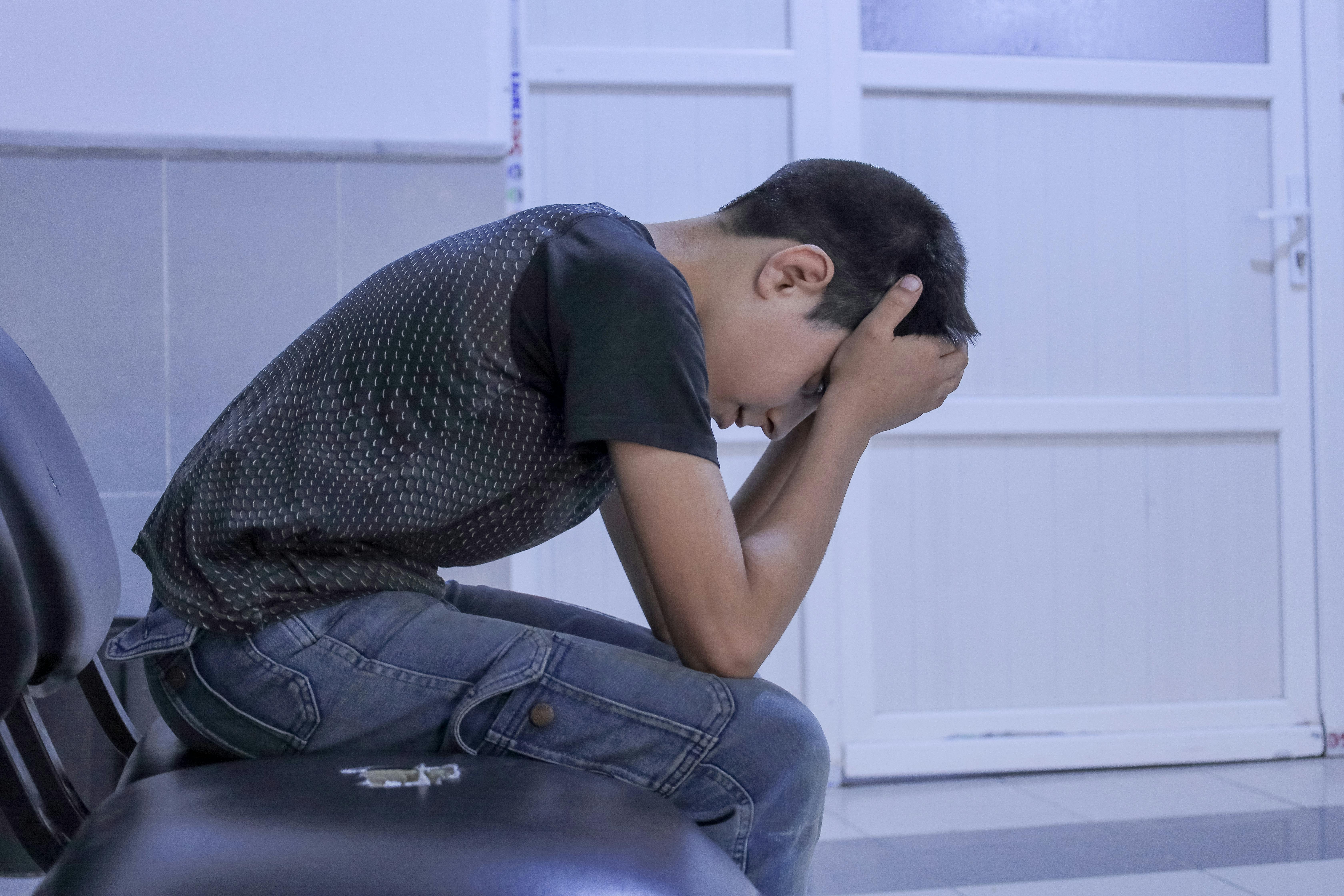
If your mornings have become a battle — the stomach aches, the tears, the “I feel sick, I can’t go” that you can’t reason them out of — you’re not alone. Your child isn’t being difficult, and you’re not doing it wrong. School refusal is one of the most common, distressing and challenging signs of childhood anxiety. And it’s something that needs resolving sooner rather than later, because the way most parents are told to handle it usually doesn’t work as well as they’d hoped.
To change that, we first have to understand what’s actually going on — because it’s rarely what it looks like on the surface.
It’s not really about the school — it’s about safety

School refusal usually isn’t about the school itself. It’s about your child’s nervous system having decided that school isn’t a safe space — and sending signals from deep within to keep them away.
Now, let me be clear: I’m not saying the school genuinely isn’t safe, or that you should keep your child home. I’m saying your child’s nervous system has perceived a threat, and in response it produces very real physical symptoms — the stomach aches, the headaches. These aren’t made up. They’re genuinely caused by anxiety and stress.
And because they’re real, they’re worth taking seriously. If your child constantly complains of stomach aches or headaches, always get it checked medically first, just to be sure nothing else is going on. But here’s a telling sign: if those symptoms disappear on weekends and holidays, and reappear on school mornings, you’re very likely looking at something driven by the nervous system rather than anything physical.
Once you understand that the symptoms are coming from a nervous system that feels unsafe, the next question is what to do about it. And this is where most of the usual advice quietly sets parents up to struggle.
What you’ve probably already been told to do
If you’ve reached out for help with this, you’ve likely heard the standard advice. Push through. Be firm. Just get them to school and they’ll settle once they’re there. Reward them for going. Reassure them that everything’s fine.
And I understand why that advice exists — on the surface, it sounds reasonable. Sometimes it even works for a day or two. But for an anxious child, it usually doesn’t hold, because it’s all aimed at the behaviour — getting them through the gate — rather than the thing actually driving it underneath. So you end up back where you started, often with mornings that are even harder than before.
There’s a reason this approach backfires so often — and it comes down to the one thing most parents are never told about anxiety.
What most parents are never told

Here it is, plainly: your child’s anxiety doesn’t come from their thinking, logical mind. It comes from much deeper — from the unconscious mind, below the level of conscious thought.
That’s the piece almost everyone misses, and it changes everything. Because if the anxiety is running underneath conscious thought, then anything aimed only at the conscious level — reasoning with them, reassuring them, rewarding them, talking them round — is working on the wrong layer. It might help for a moment, but it rarely holds, because it never reaches the place the anxiety actually lives.
This is why you can’t simply talk a child out of anxiety. And it’s why lasting change has to happen on two levels at once — what you do on the surface, and what shifts underneath.
So let’s start with what you can do.
What you can actually do
First, you need to understand what’s going on for your child on the surface. Some children will tell you everything about their day; others hold it close. So find a calm time and space, and let your child know it’s safe to share. Is it a friend problem? A teacher problem? Something about the work?
Whatever surfaces, that issue isn’t ultimately what needs fixing — but knowing it gives you the full picture. For example, if your child says “I don’t have any friends,” it’s worth gently checking with the school. Are they genuinely being left out — sitting alone at lunch? Sometimes that’s the case and needs addressing. But often it’s not that at all — the child is surrounded by friends and simply doesn’t feel connected.
That gap — between what’s actually happening and how your child experiences it — points to the single most important shift I can offer you.
The shift that changes everything: it’s a skill, not a flaw

Your child’s anxiety isn’t a flaw in them. It’s the sign of a skill that hasn’t yet been developed.
That one shift changes everything — because it removes the blame. No blame on you, no blame on your child, no blame on the teacher. Just a skill that hasn’t been learned yet. And once you see it that way, you suddenly have something you can actually work with.
Take the child who feels they have no friends. What they probably haven’t developed yet is the skill of connecting with the people around them. So as parents, sometimes we have to look honestly at ourselves too: how good am I at connecting, and how do I do it? Because that’s the skill — and children learn it less from what we say than from watching how we do it ourselves. If you’ve mastered it, you can teach it. And if you haven’t, that’s something to build in yourself first, so you can show them how.
One thing every parent needs to understand: avoidance
As you work through this, there’s one pattern you need to understand, because it quietly undoes everything else if you miss it — and that’s avoidance.
Every single time your child avoids the thing that scares them, their nervous system quietly concludes that thing really was dangerous. So while letting them stay home brings relief in the moment, it teaches the brain that the fear was justified — and the anxiety grows rather than settles. School refusal doesn’t get better by waiting it out.
This is why the goal is never to push them through it or to let them avoid it — but to help them take steps small enough to feel manageable, so their nervous system learns, bit by bit, that they can cope. That’s how confidence is built: not talked into a child, but experienced.
How I work — beneath the surface
Teaching the skill on the surface matters. But on its own, it’s only part of the picture.
The way I work as a therapist is to go deeper — working with the nervous system, and reprogramming those patterns at the level of the unconscious mind. Because, as we’ve seen, that’s where the anxiety actually lives.
So lasting change takes three things working together: understanding what’s happening on the surface, teaching and modelling the missing skill, and changing the pattern deeper within — so the nervous system stops sounding the alarm. Address only one layer, and it tends to creep back. Work all three, and the change holds.
You’re not failing
So if you’ve tried everything and you’re still standing at the school gate with an anxious child, please hear this: you haven’t done anything wrong. Anxiety isn’t a flaw, and it isn’t your fault — it’s a skill waiting to be built, and that’s something we can absolutely work on, together
If you’d like to understand more, you can download my guide, [The Real Reason Your Child Is Anxious], which explains the hidden patterns driving childhood anxiety. Or, if you’d like to talk it through, you’re welcome to [book a free call].